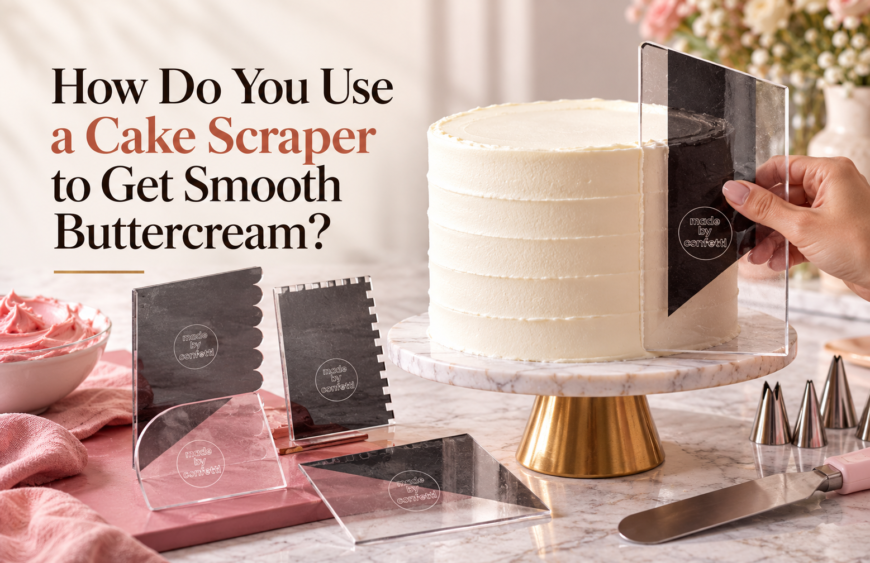
If you want to know how to smooth buttercream cake, the secret is not simply scraping the frosting until it looks flat. The key is to apply enough buttercream, hold your cake scraper at the right angle, and let the cake rotate steadily against the scraper.
For the smoothest finish, place the cake on a revolving turntable, hold the scraper at approximately a 45-degree angle, and keep your scraping hand steady while rotating the cake. The scraper should distribute and level the buttercream rather than remove too much of it.
A smooth buttercream finish gives your cake a clean foundation for piping, cake toppers, edible details, or other decorations. And once you get comfortable with the technique, it becomes one of the most useful skills in cake decorating.
What Is a Cake Scraper Used For?
A cake scraper is a flat decorating tool designed to smooth and even out frosting around the sides of a cake. It helps remove excess buttercream while creating a consistent surface.
When using a cake scraper for buttercream, the goal is not to strip the frosting from the cake. Instead, you want to gently level the surface while leaving enough buttercream to fill small gaps and create an even finish.
For beginners, a scraper can make the sides of a cake look much more consistent than trying to achieve the same result with an offset spatula alone.
What You Need Before You Start
Before reaching for your cake scraper, prepare a few essentials:
- A completely cooled cake
- Buttercream with a smooth, spreadable consistency
- A sturdy cake board
- A revolving turntable
- An offset spatula
- A cake scraper
- A small bowl for excess buttercream
The cake should also be stable on the turntable. If the cake board moves while you scrape, it becomes much harder to maintain an even finish.
For beginners, it is worth getting your setup right before you start decorating. A stable cake and steady turntable can make the technique feel much easier.
Step 1: Start With a Crumb Coat
Before applying your final layer of buttercream, cover the cake with a thin crumb coat.
A crumb coat is a light layer of buttercream that traps loose cake crumbs and creates a more stable surface for the final frosting layer.
Once the crumb coat is applied, chill the cake until the frosting feels firm.
This step is particularly helpful when learning how to smooth buttercream cake, because loose crumbs are less likely to appear in your final finish.
Step 2: Apply Plenty of Buttercream
It may feel counterintuitive, but do not apply an extremely thin layer of buttercream before using the scraper.
Spread a generous layer over the top and sides of the cake using an offset spatula. Make sure there is enough frosting to cover the entire surface.
It is much easier to remove excess buttercream with a scraper than to discover bare patches and try to repair them afterwards.
Focus on coverage first. You can create the smooth finish in the next step.
Step 3: Hold the Cake Scraper at a 45-Degree Angle
This is one of the most important parts of using a cake scraper for buttercream.
Place the bottom edge of the scraper against the turntable or cake board and gently position the scraper against the side of the cake.
Hold it at approximately a 45-degree angle rather than placing it completely perpendicular to the cake.
A scraper held too aggressively against the frosting can remove too much buttercream and create grooves or bare patches.
Think of the scraper as a levelling tool. You are guiding the buttercream into an even surface, not trying to scrape the cake clean.
Step 4: Keep the Scraper Still and Rotate the Cake
This is where the turntable does most of the work.
Keep your scraping hand steady while using your other hand to slowly rotate the turntable. Let the cake move against the edge of the scraper.
Try to maintain consistent pressure throughout the rotation.
Avoid moving the scraper back and forth around the cake. A controlled, steady rotation generally gives you a more consistent result.
If your arm becomes uncomfortable, stop, wipe the excess buttercream from the scraper, and continue.
Step 5: Check for Gaps and Air Pockets
After one or two passes, take a close look at the cake.
You may notice small holes, air pockets, dents, or areas where the scraper has removed slightly too much buttercream. Do not keep scraping and hope they disappear.
Instead, use your offset spatula to add a small amount of fresh buttercream to the low areas.
Then return to the cake scraper and make another controlled pass.
This fill-and-scrape process is completely normal. Smooth cakes are often created through several small corrections rather than one perfect rotation.
Step 6: Clean Up the Top Edge
As you smooth the sides, excess buttercream will often collect around the top edge of the cake.
Once the sides are smooth, use a clean offset spatula or scraper to gently pull this excess frosting from the outer edge towards the centre.
Work carefully and wipe your tool clean between passes.
This final step helps create a sharper top edge and gives the cake a cleaner, more finished appearance.
Tips for a Smoother Buttercream Finish
Remove air bubbles from your buttercream
Air pockets in your buttercream can create small holes as you scrape the cake. Before decorating, gently work the buttercream with a silicone spatula to help reduce trapped air.
Keep your scraper clean
Buttercream builds up on the edge of the scraper during each pass. Wipe it clean before returning to the cake so you are working with a smooth edge.
Do not press too hard
More pressure does not necessarily create a smoother cake. If you press too firmly, you can remove too much frosting and expose the cake underneath.
Let the scraper do the levelling.
Try a warm scraper for the final pass
If you are using a metal cake scraper, a warm final pass can help soften the outer surface of the buttercream slightly and reduce tiny lines.
Dip the scraper in warm water, wipe it completely dry, and then make a gentle final pass.
The important part is that the scraper is dry before touching the cake.
Which Cake Scraper Should Beginners Use?
The best cake scraper is one that feels comfortable in your hand and gives you enough surface area to work around the cake.
For beginners, a straightforward scraper is usually enough to learn the basic technique. Once you are comfortable with smooth buttercream, you can experiment with different scraper shapes and decorating tools to create textures and finishes.
A well-chosen cake decorating tool should make the process simpler, not more complicated. This fits the Made by Confetti approach to cake decorating: practical tools, thoughtful design, and techniques that help bakers create a polished finish without feeling overwhelmed.
Explore the Cake Scrapers collection when you are ready to practise smooth buttercream finishes.
The Simple Formula for Smooth Buttercream
If you are still wondering how to use a cake scraper, remember this simple sequence:
Crumb coat → Chill → Apply generous buttercream → Hold scraper at 45° → Rotate the turntable → Fill gaps → Scrape again → Clean the top edge.
The first cake may not have perfectly straight sides, and that is completely fine. Cake smoothing is a technique that becomes easier with practice.
Once your hand learns how much pressure to use and how quickly to rotate the turntable, the scraper starts doing much of the work for you.
FAQs About Using a Cake Scraper
1. What angle should you hold a cake scraper?
For smoothing buttercream, hold the cake scraper at approximately a 45-degree angle against the cake. Keep the scraper steady while rotating the turntable to create an even surface.
2. Why does my cake scraper remove too much buttercream?
You may be applying too much pressure, holding the scraper too upright, or starting with too little buttercream. Apply a generous layer and use gentle, controlled pressure while rotating the cake.
3. Do I need a turntable to use a cake scraper?
A turntable makes the process considerably easier because it allows the cake to rotate smoothly against a stationary scraper. You can attempt the technique without one, but achieving an even finish is generally more difficult.
4. How do I fix holes in buttercream after scraping?
Add a small amount of fresh buttercream to the hole or low spot using an offset spatula. Then rotate the cake and make another gentle pass with the scraper.
5. Can I use a warm cake scraper for buttercream?
If you are using a metal scraper, a warm, completely dry scraper can be useful for a final smoothing pass. The gentle warmth can soften the outer layer of buttercream and help minimise fine scraper lines.