If you want to add a little sparkle to a cake, two decorating products often come up: edible glitter and luster dust. They may look similar in the pot, but they create very different finishes on cakes, cupcakes, fondant, and other desserts.
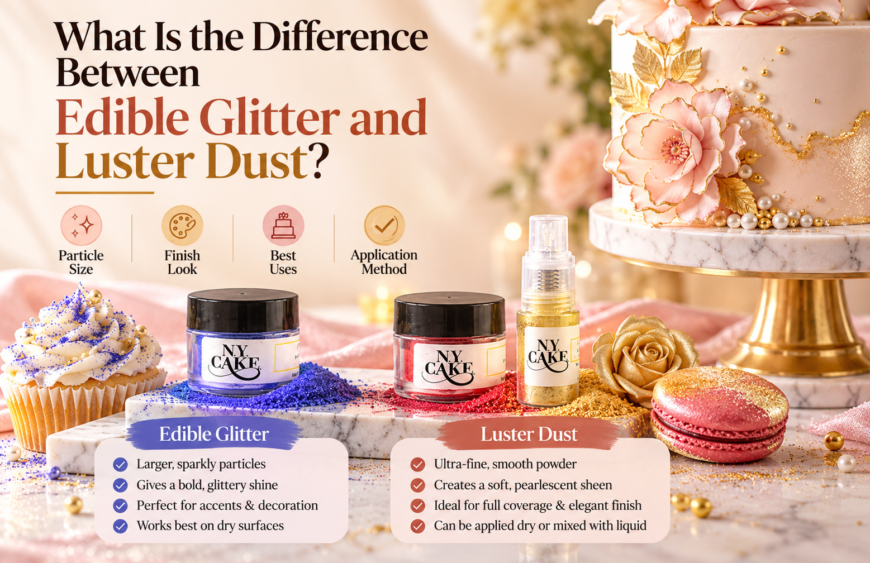
The simplest difference is this: edible glitter creates a more noticeable, sparkling effect, while luster dust creates a smooth, pearlescent or metallic sheen. Edible glitter generally has larger particles or flakes, whereas luster dust is an ultra-fine powder.
Choosing between them depends on the finish you want, the surface you are decorating, and how you plan to apply it. Here is a simple guide to help you decide.
Edible glitter vs luster dust: what is the difference?
| Feature | Edible glitter | Luster dust |
| Texture | Larger grains or flakes | Ultra-fine powder |
| Finish | Bold, sparkling effect | Smooth, pearlescent or metallic sheen |
| Application | Usually sprinkled or sprayed dry | Dry-brushed, airbrushed, or painted |
| Best for | Buttercream, icing, cupcakes, celebration cakes | Fondant, chocolate, sugar flowers, detailed decorations |
| Overall look | Twinkling and eye-catching | Elegant and polished |
So, if you want your cake to catch the light with visible sparkle, choose edible glitter. If you want a soft metallic glow or sophisticated sheen, luster dust is usually the better choice.
What is edible glitter?
Edible glitter is a decorative ingredient designed to create visible sparkle on food. Compared with luster dust, its particles are larger, allowing individual flakes or grains to catch the light.
This makes edible glitter particularly useful when you want the decoration to be part of the cake’s visual statement rather than simply adding a subtle shimmer.
What does edible glitter look like on cakes?
The effect is bold and playful. Depending on the colour and amount used, edible glitter can give a cake a noticeable twinkling or multi-faceted finish.
It works especially well for:
- Birthday cakes
- Celebration cakes
- Cupcakes
- Festive desserts
- Buttercream cakes
- Royal icing decorations
- Cakes with a glamorous or party-inspired theme
If you are looking for edible glitter for cakes, think about the overall design first. A small amount can highlight a particular detail, while a heavier application can create a much more dramatic sparkle.
How do you apply edible glitter?
Because edible glitter consists of larger particles, it is generally best applied dry.
You can sprinkle it directly onto a surface that is slightly tacky, such as fresh buttercream or wet royal icing. It can also be applied to fondants when the surface has a suitable edible adhesive or a small amount of moisture to help the glitter stick.
The key is to apply it where you want the sparkle to remain visible.
For example, instead of covering an entire cake with glitter, you could use it to highlight:
- The edges of a cake
- Piped borders
- Fondant shapes
- Cake lettering
- Decorative flowers
- Specific sections of a celebration cake
This gives you more control and keeps the finished design looking intentional.
What is luster dust?
Luster dust is an ultra-fine decorating powder used to give cakes and confectionery a smooth shimmer or metallic appearance.
Unlike edible glitter, it does not usually create individual points of sparkle. Instead, the fine powder catches and reflects light across the surface, creating a continuous sheen.
That makes luster dust for cakes particularly useful when you want an elegant finish rather than a dramatic glitter effect.
It can be used to create effects resembling:
- Gold
- Silver
- Rose gold
- Pearlescent white
- Soft metallic colours
- Subtle coloured shimmer
Luster dust can be especially effective on fondant decorations, sugar flowers, chocolate details, and other structured cake elements.
How do you apply luster dust?
One of the biggest advantages of luster dust is its versatility.
For a soft, subtle finish, you can apply it dry with a suitable food-safe brush. This technique works well when you want to highlight raised details, moulded fondant, sugar flowers, or textured decorations.
For more defined decorative work, luster dust can also be mixed with a suitable liquid to create a paint-like consistency. This allows you to add metallic lines, lettering, accents, or other fine details.
The application method changes the final appearance, so it is worth testing the colour and consistency on a small piece of decoration before working directly on your finished cake.
When should you use edible glitter instead of luster dust?
Choose edible glitter when your priority is sparkle.
It is a good option when you want a cake to feel:
- Fun
- Festive
- Glamorous
- Playful
- Bold
- Celebration-ready
For example, a birthday cake with a simple buttercream finish can instantly feel more celebratory when edible glitter is used selectively around the lettering or decorative details.
When should you use luster dust instead?
Choose luster dust when you want a more refined finish.
It works beautifully when your design calls for:
- Metallic details
- Elegant fondant decorations
- Sugar flowers
- Fine lettering
- Chocolate decorations
- Soft pearlescent highlights
For a wedding, engagement, anniversary, or sophisticated celebration cake, luster dust can add dimension without overwhelming the rest of the design.
The choice really comes down to sparkle versus sheen.
Can you use edible glitter and luster dust together?
Yes, they can complement each other when used thoughtfully.
For example, you could use luster dust to create a smooth gold finish on fondant lettering and add a small amount of edible glitter around the decoration for extra sparkle.
The trick is not to make every surface compete for attention. Choose one finish as the main effect and use the other as an accent.
This approach is especially useful for cake decorators who want a layered, design-led finish rather than simply adding glitter everywhere.
How do you know if glitter or dust is safe for cakes?
This is one detail that should never be overlooked.
Always check that the product is specifically labelled “edible” and is intended for use on food. Some decorative glitter and dust products may be labelled “non-toxic” or “for decorative purposes only”. Those descriptions do not mean that the product is suitable for consumption.
If you are decorating a cake that will be eaten, check the product label and ingredient information before applying it.
Edible glitter or luster dust: which one should you choose?
If you are still unsure, use this quick rule:
Choose edible glitter for sparkle. Choose luster dust for sheen.
Edible glitter is ideal when you want visible, playful sparkle on a celebration cake. Luster dust is better when you want a smooth metallic or pearlescent finish on fondant, chocolate, sugar flowers, or detailed decorations.
Neither is necessarily “better”. They simply create different visual effects.
The best choice depends on your cake design, the surface you are decorating, and how dramatic you want the final finish to be.
For a polished cake, start with the effect you want to achieve, then choose the decorating product that supports it. A little glitter can create the wow, while a touch of luster can make carefully crafted details catch the light beautifully.
FAQs
Is edible glitter the same as luster dust?
No. Edible glitter generally contains larger particles or flakes that create visible sparkle, while luster dust is a fine powder that produces a smoother pearlescent or metallic sheen.
Can you use edible glitter on buttercream?
Yes. Edible glitter can be applied to a slightly tacky buttercream surface so that the particles adhere. It is particularly effective for adding sparkle to borders, lettering, or selected decorative areas.
Can luster dust be used directly on cakes?
Yes, provided the product is specifically labelled for edible use. Luster dust can be dry-brushed onto suitable cake decorations or used in an appropriate edible painting mixture for more detailed effects.
Is luster dust better than edible glitter for fondant?
It depends on the look you want. Luster dust for cakes is usually better when you want a smooth metallic or pearlescent finish on fondant. If you want obvious sparkle, edible glitter is the better choice.
How can I make sure cake glitter is edible?
Always read the product label and ingredient information. Look specifically for products that state they are edible and intended for food use. Do not assume that “non-toxic” or “decorative” automatically means safe to eat.