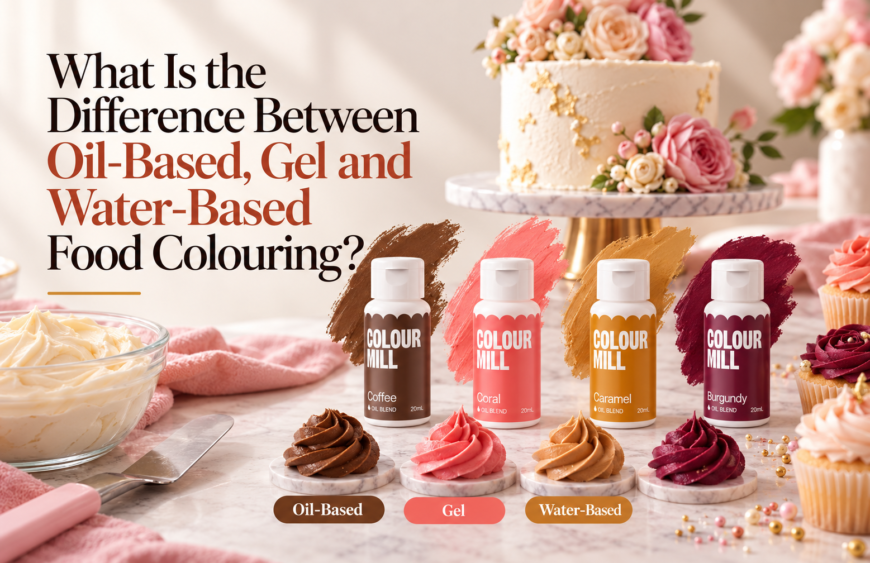
Choosing the right food colouring can make a big difference to the final look and texture of your bake. If you have ever wondered whether you should use oil based food colouring, gel food colouring, or water based food colouring, the answer depends largely on what you are trying to colour.
The main difference between these three types is their base carrier liquid. That base affects how concentrated the colour is, how easily it mixes, and which ingredients it works best with.
For example, adding a water-based colour to melted chocolate can cause the chocolate to seize, while an oil-based colour is designed to blend smoothly with chocolate and other fat-rich ingredients. Gel colours sit somewhere in between, offering concentrated colour with very little added moisture.
So, when comparing oil based vs gel food colouring, it is less about choosing one universal “best” option and more about choosing the right colour for the ingredient you are working with.
Oil-Based vs Gel vs Water-Based Food Colouring: At a Glance
| Feature | Water-Based Food Colouring | Gel Food Colouring | Oil-Based Food Colouring |
| Base | Water | Glycerin or corn syrup | Oil or liquid fat |
| Consistency | Thin and liquid | Thick and concentrated | Liquid and slightly viscous |
| Colour intensity | Light to moderate | Vibrant and concentrated | Deep and vibrant |
| Best for | Batters, doughs, icings | Fondant, buttercream, macarons | Chocolate, candy melts, buttercream |
| Main consideration | Can add moisture | Needs thorough mixing | Works best with fat-based ingredients |
The simplest way to remember the difference is:
Water-based colours add colour with more liquid, gel colours add strong colour with minimal moisture, and oil-based colours are made to blend with fat-rich ingredients.
What Is Water-Based Food Colouring?
Water based food colouring is one of the most common types of food colouring. As the name suggests, water is the primary carrier, which gives the colour a thin, highly liquid consistency.
It can be useful when you want to add colour to ingredients that already contain water or moisture.
When should you use water-based food colouring?
Water-based colouring can work well for:
- Cake batters
- Cookie doughs
- Simple icings
- Certain liquid mixtures
- Applications where a lighter or pastel shade is suitable
Because the colour is relatively diluted, you may need to add more of it to achieve a deeper shade.
That is also where the main drawback appears. Adding too much liquid colouring can change the consistency of your mixture.
More importantly, water and melted chocolate do not work well together. Even a small amount of water can cause melted chocolate to seize and become thick and grainy rather than smooth.
So, if chocolate is your canvas, reach for an oil-based colour instead.
What Is Gel Food Colouring?
Gel food colouring has a much thicker, concentrated consistency. It is popular for cake decorating because you can achieve a strong colour without adding a large amount of liquid to your recipe.
This makes gel colour particularly useful when the consistency of your mixture matters.
When should you use gel food colouring?
Gel colours are well suited to:
- Fondant
- Buttercream
- Royal icing
- Macarons
- Marzipan
- Whipped cream
- Cake decorations where vibrant shades are needed
A small amount can produce an intense colour, making gel food colouring a practical choice when you want to build a strong colour gradually.
For example, instead of adding a large amount of liquid colouring to buttercream and potentially making it softer, a concentrated gel can give you more colour with less added moisture.
What should beginners watch out for?
The main challenge is mixing.
Because gel colour is thick, it needs to be distributed evenly. This can be particularly important when colouring a large quantity of stiff fondant or dough.
Start with a small amount, mix thoroughly, and build the colour gradually. It is much easier to add more colour than to correct an overly intense shade.
What Is Oil-Based Food Colouring?
Oil based food colouring is formulated to work with ingredients that are rich in fat or oil.
Unlike water-based colouring, it integrates more naturally into fat-based mixtures, making it particularly useful for chocolate and similar applications.
When should you use oil-based food colouring?
Oil-based colours are especially useful for:
- Chocolate
- Cocoa butter
- Candy melts
- Chocolate decorations
- High-fat buttercreams
- Other fat-rich mixtures
This is where the difference between oil based vs gel food colouring becomes particularly important.
If you are colouring melted chocolate, an oil-based colour is generally the better match because its oil-based carrier is compatible with the chocolate’s fat content.
The colour can blend into the mixture without introducing the water that can cause chocolate to seize.
Oil-Based vs Gel Food Colouring: Which One Should You Choose?
If you are deciding between oil based vs gel food colouring, think about the ingredient you are colouring first.
Choose oil-based colouring when:
- You are working with chocolate.
- You are colouring candy melts.
- You are working with cocoa butter.
- You need colour to blend into a fat-rich mixture.
- You want a deep colour without introducing water.
Choose gel food colouring when:
- You are colouring fondant.
- You are decorating with buttercream.
- You are making macarons.
- You need concentrated, vibrant colour.
- You want to minimise additional liquid.
Neither is automatically better. They are simply designed for different jobs.
For bakers who regularly work with both buttercream and chocolate, having more than one type of food colour in your decorating kit can make colour matching much easier.
Can You Use Water-Based Colouring in Chocolate?
This is one of the most important food colouring questions for beginners.
It is best to avoid water-based food colouring in melted chocolate.
The water content can cause the chocolate to seize, changing it from a smooth, fluid consistency into a thick, grainy mixture that is difficult to work with.
If you are colouring chocolate, choose a colour specifically designed to work with fat-based ingredients, such as an oil-based food colour.
The same principle applies when working with candy melts and cocoa butter: always consider whether the colour’s base is compatible with the ingredient you are trying to colour.
How to Choose the Right Food Colour for Your Bake
Before adding any colour, ask three simple questions:
1. What am I colouring?
Chocolate, fondant, buttercream, batter, or another mixture?
2. How much additional moisture can it handle?
If the answer is “very little”, a concentrated gel or oil-based colour may be more suitable than a thin water-based colour.
3. How intense do I want the colour to be?
For vibrant shades, concentrated colours can help you achieve the result without adding excessive amounts of liquid.
This small check can save you from changing the texture of an otherwise perfect recipe.
The Simple Rule to Remember
Food colouring does not work the same way across every recipe.
Water-based food colouring is useful for moisture-friendly mixtures where lighter colour can be acceptable. Gel food colouring is a concentrated option for applications such as fondant, buttercream, and other decorating work where you want strong colour without adding much liquid. Oil based food colouring is the natural choice when working with chocolate, cocoa butter, candy melts, and other fat-rich ingredients.
When in doubt, match the base of the colour to the base of the ingredient.
If your recipe is fat-heavy, look towards oil-based colouring. If you need concentrated colour for cake decorating, gel is often a practical choice. For simple batters and liquid-friendly applications, water-based colour can do the job.
For bakers who care about clean colour, consistent finishes, and getting the shade right without compromising the texture of their bake, choosing the right food colouring is one small decision that makes a noticeable difference.
Explore the Colour Mill range for food colouring options designed for creative cake and dessert decorating.
FAQs
Is oil-based food colouring better than gel food colouring?
Not necessarily. The better choice depends on what you are colouring. Oil-based food colouring is particularly suited to chocolate, cocoa butter, and other fat-rich ingredients, while gel food colouring is useful for fondant, buttercream, macarons, and other decorating applications.
Can I use gel food colouring in chocolate?
Gel food colouring is not the first choice when colouring melted chocolate because chocolate is sensitive to water. For chocolate, candy melts, and cocoa butter, an oil-based food colouring is a better match.
What is the best food colouring for buttercream?
Both gel and oil-based food colouring can be used for buttercream, depending on the formulation and desired result. Gel colouring is a popular choice when you want concentrated colour without adding much moisture.
Why does water-based food colouring make chocolate seize?
Water-based food colouring contains water, while chocolate is primarily a fat-based mixture. Introducing water can disrupt the chocolate’s smooth structure, causing it to become thick and grainy instead of remaining fluid.
Which food colouring gives the most vibrant colour?
Gel and oil-based food colourings can both produce strong, vibrant shades. Gel is highly concentrated and useful for many cake decorating applications, while oil-based colouring is particularly effective when working with chocolate and other fat-rich ingredients.